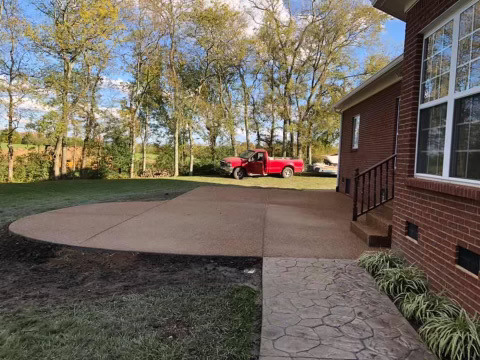
Homeowners ask us this more than any other question: 'Why did my driveway crack?' The honest answer is that concrete cracks — it is a rigid material under stress from load, temperature, and ground movement. The better question is whether the cracks are planned and harmless, or unplanned and a sign of failure. Most unplanned cracking comes down to five causes, and four of them are preventable.
01Cause 1: A weak or uncompacted sub-base
The ground under your driveway does as much work as the concrete above it. If the sub-base is soft, uneven, or full of organic material, the slab above it flexes and cracks under vehicle weight. In Middle Tennessee, clay soils hold water and shift with the seasons, which makes sub-base preparation even more critical here than in sandy regions.
Prevention: have the sub-base excavated to a consistent depth, compacted, and topped with a gravel base before forms are set. This is not where you want the cheapest bid cutting corners.
02Cause 2: Missing or poorly placed control joints
Control joints are deliberate weak lines that tell the concrete where to crack. Without them, the concrete picks its own crack location — usually the worst possible one. Joints should be spaced at roughly 2 to 3 times the slab thickness in feet (so a 4-inch slab gets joints every 8 to 12 feet), cut to a depth of one-quarter the slab thickness, and placed soon after the pour.
Prevention: insist that your contractor plans joint layout and cuts them at the right time — within 4 to 12 hours of finishing, before the concrete has fully cured.
03Cause 3: A pour that is too thin
A residential driveway should be at least 4 inches thick — 5 inches where heavier vehicles or RVs will park. Thin concrete flexes under load and cracks. The thickness is set by the form height and the grade of the sub-base underneath, which is why sub-base prep and thickness are related.
Prevention: specify the finished thickness in the estimate, and verify the crew is pouring to that depth across the entire slab, not just at the forms.
04Cause 4: Poor drainage and water management
Water is the enemy of concrete over the long run. If your driveway pitches water toward the foundation, or if water sits at the edges and saturates the sub-base, the slab will settle and crack. Driveways should pitch away from the house and shed water to the sides or to a planned drain.
Prevention: a good contractor checks pitch before pouring. On sloped Tennessee lots, this is not optional — it is the difference between a driveway that lasts and one that fails.
05Cause 5: Freeze-thaw and de-icing chemicals
Middle Tennessee freezes and thaws repeatedly each winter. Moisture that gets into surface pores expands when it freezes and chips the surface — a process called scaling. De-icing salts accelerate this dramatically, especially on concrete that was not air-entrained or properly cured.
Prevention: use air-entrained concrete, cure it properly, apply a penetrating silane-siloxane sealer after the first 28 days, and avoid sodium chloride de-icers in the first winter. Sand is a safer traction alternative on new concrete.
06Which cracks are normal?
Hairline cracks inside control joints are normal — that is what the joints are there for. Random cracks across the middle of the slab, especially wide ones or ones that line up on both sides of a joint, are not. Edge cracks that run parallel to the forms often indicate sub-base failure. When in doubt, have a contractor look at it before it widens.
Key Takeaway
Most unplanned driveway cracks come from sub-base, thickness, control joints, drainage, or freeze-thaw. Four of the five are preventable with proper prep, reinforcement, joints, curing, and sealing.
Related Service
Concrete Driveways & Paving
Durable, high-load concrete driveway pour, replacement, widening, and custom finishes.
View service details & pricingMore on Driveways
Ready to talk to a real concrete crew?
Free on-site estimates across Middle & Southern Tennessee. No obligation.