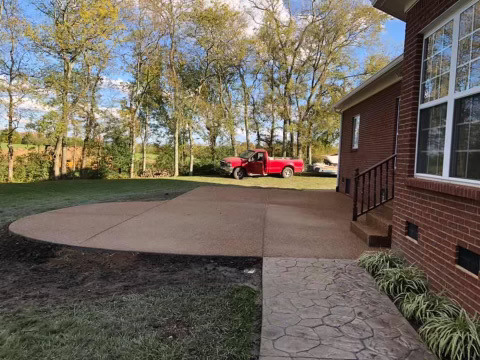
Thickness is the most under-discussed part of a driveway pour. Homeowners compare mix, finish, and price, but the single biggest predictor of how long a driveway lasts is how thick it is. A thin driveway fails under load long before the concrete itself is tired. Here is how we spec thickness for the driveways we pour across Middle and Southern Tennessee.
01The baseline: 4 inches for passenger vehicles
For a standard residential driveway carrying cars, SUVs, and light pickups, 4 inches is the minimum we recommend. At 4 inches with a proper sub-base and reinforcement, a concrete driveway handles the weight of a daily-driver vehicle without issue. Below 4 inches, you are in sidewalk territory, and vehicles will overstress it.
Four inches is not a guess — it is the spec that balances material cost against the load a typical vehicle places on the slab over thousands of cycles.
025 inches for trucks, SUVs, and heavier use
If the driveway will regularly carry full-size pickups, work trucks, or heavier SUVs, we bump to 5 inches. The extra inch roughly doubles the load capacity of the slab because strength scales with the square of thickness. The cost difference is modest; the durability difference is significant.
For most Tennessee families, 5 inches is the sweet spot — it handles everything short of commercial vehicles and lasts decades.
036 inches for RVs, trailers, and commercial traffic
RVs, loaded trailers, and any commercial vehicle warrant 6 inches or more, plus heavier reinforcement and a beefed-up sub-base. A 6-inch slab is a different beast — it is essentially a light commercial pour. If you are parking an RV or a boat trailer on the slab, do not let anyone pour it at 4 inches.
04Thickness is only as good as the sub-base
A 6-inch slab on soft ground will crack where a 4-inch slab on a well-compacted gravel base will not. Thickness and sub-base work together — the slab spreads load, and the sub-base carries it. On Tennessee clay, we compact and add gravel under almost every pour. If a contractor quotes a thick slab without addressing the sub-base, the thickness is wasted.
05Reinforcement is part of the thickness story
Steel reinforcement — rebar or wire mesh — sits in the middle of the slab, not on the dirt. The point of the steel is to hold cracks together and spread load. A 4-inch slab with rebar chaired up into the concrete outperforms a 5-inch slab with mesh lying on the sub-base. Ask how reinforcement is placed, not just whether it is included.
06What thickness does not fix
Thickness does not compensate for bad drainage, missing control joints, or a bad mix. A thick driveway that pitches water toward the foundation will still fail. Thickness is one variable in a system — get the mix, sub-base, reinforcement, joints, and drainage right, and the thickness does its job.
Key Takeaway
Spec 4 inches for passenger cars, 5 inches for trucks and SUVs, and 6 inches for RVs and commercial traffic. Pair the thickness with a compacted sub-base, mid-slab reinforcement, and proper drainage.
Related Service
Concrete Driveways & Paving
Durable, high-load concrete driveway pour, replacement, widening, and custom finishes.
View service details & pricingMore on Driveways
Ready to talk to a real concrete crew?
Free on-site estimates across Middle & Southern Tennessee. No obligation.