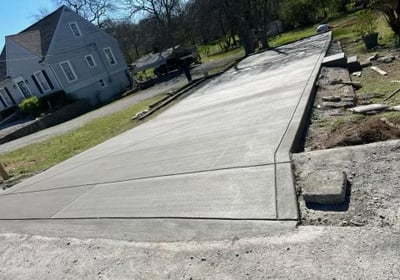
Most homeowners want to save the driveway they have. It is understandable — replacement is an investment. But there is a point where repair becomes money spent postponing an inevitable tear-out, and a point where a simple repair buys you another decade. Knowing which side of that line you are on is what a good contractor helps you figure out. Here is how we evaluate a driveway.
01Start with the extent of the cracking
A few hairline cracks inside the control joints are normal aging and not a reason to replace. Wider cracks, especially ones a quarter inch or more, indicate movement in the slab or sub-base. When cracks start to line up across multiple joints or run across the slab in a pattern, the driveway is telling you the ground underneath is no longer supporting it evenly.
As a rough rule: if less than 20 percent of the surface has meaningful cracking, repair is usually viable. If you are patching more than half of it, replacement is typically the better long-term call.
02Look for settling and heaving
If one section of the driveway has sunk an inch or more relative to another, or if slabs have heaved up at the joints, the sub-base has failed or water has undermined it. Patching the surface does nothing to fix the problem underneath — the movement will continue and the repair will fail.
Settling at the garage or foundation is particularly worth taking seriously, because it usually means water has been running where it should not.
03Surface scaling vs. structural problems
Scaling — the flaky, dusty surface that comes off under a broom — is a surface problem, often from freeze-thaw and de-icing salts on concrete that was not properly cured or sealed. Scaling looks bad but does not necessarily mean the driveway is structurally done. A polymer overlay or resurfacing can restore the appearance in the right circumstances.
Structural cracking, settlement, and broken edges are different. Those indicate the slab itself has failed and overlays will not hold.
04When repair makes sense
Repair is a good call when the cracking is limited, the slab is stable, drainage is sound, and the surface is mostly intact. Crack filling, joint resealing, a thin overlay, or replacing one damaged section while keeping the rest are all legitimate repairs when the conditions are right. Done well, they buy you years.
05When replacement is the better investment
Replacement is the right call when the cracking is widespread, the sub-base has failed, multiple sections have settled, drainage is wrong and has been wrong for a while, or the slab is thin and was poured without proper reinforcement. The cost of repeated repairs on a failing driveway often exceeds the cost of one proper replacement within a few years.
A new driveway poured with the right mix, reinforcement, sub-base, control joints, and drainage is a 30-to-40-year asset. That is the math to compare against.
06Have a contractor evaluate it in person
Photographs help, but the only way to truly evaluate a driveway is on site — to tap it, check the pitch, look at the joints, and see what the ground underneath is doing. We do free evaluations across Middle and Southern Tennessee because the right answer is different for every property.
Key Takeaway
Repair a driveway when the cracking is limited and the slab is stable. Replace it when the sub-base has failed, cracking is widespread, or drainage is wrong. Have a contractor evaluate in person before deciding.
Related Service
Concrete Repair & Resurfacing
Crack repair, spalling remediation, resurfacing overlays, and protective weather sealing.
View service details & pricingMore on Driveways
Ready to talk to a real concrete crew?
Free on-site estimates across Middle & Southern Tennessee. No obligation.