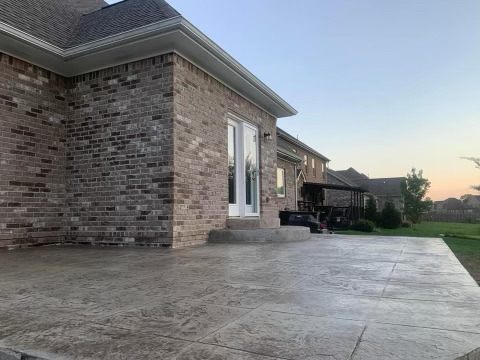
Stamped concrete is one of the most popular decorative concrete options in Middle Tennessee because it gives you the look of stone, slate, or wood at a fraction of the cost of the real material. But it is not the same product as a standard broom-finished slab, and it carries different costs and maintenance needs. Here is an honest comparison so you can choose the right finish for your project.
01What stamped concrete actually is
Stamped concrete is a regular concrete pour with a surface treatment applied while the concrete is still wet. Integral color is mixed into the entire batch, a color hardener is broadcast onto the surface, and then rigid stamping mats are pressed into the wet concrete to imprint a pattern — ashlar slate, cobblestone, wood plank, flagstone, and many others. A release agent keeps the mats from sticking and adds a secondary 'antique' color.
The result is a slab that reads as natural stone or wood from a few feet away but costs a fraction of installing those materials.
02Appearance and design range
This is where stamped concrete wins. The pattern and color options are wide, and a good installation can transform a plain patio into something that looks high-end. Traditional concrete is a uniform gray surface — functional, clean, and honest, but not a design statement.
For front entries, courtyards, and patios visible from the street, stamped concrete adds curb appeal that translates to resale value. For a backyard utility pad or a driveway where durability is the only priority, traditional may be the better call.
03Cost
Stamped concrete runs roughly 30 to 50 percent more than a standard broom finish, depending on the pattern complexity, number of colors, and sealers used. The premium is in the labor and the materials — color hardener, release agent, stamps, and the slower, more careful finishing process.
It is still typically less expensive than natural stone, brick, or pavers installed over a concrete base.
04Durability and structural performance
Structurally, both stamped and traditional concrete use the same mix, sub-base, and reinforcement underneath. The stamping is a surface treatment, not a structural change. A properly installed stamped patio and a properly installed broom patio will carry the same load and last about the same number of decades.
The difference is in the surface: stamped concrete has a textured, patterned surface that can be slightly more prone to wear at the high points of the pattern. A high-quality sealer protects it.
05Maintenance
Traditional concrete is low maintenance — clean it and reseal occasionally. Stamped concrete needs more attention: the sealer should be reapplied every 2 to 3 years to protect the color and pattern, and it should be cleaned to keep dirt out of the texture. Without resealing, stamped concrete fades and the patterned surface can wear.
If you want install-and-forget, traditional is the better fit. If you are willing to maintain it, stamped stays beautiful for a long time.
06Slip resistance around pools
Wet stamped concrete can be slippery, especially with a glossy sealer. Around a pool, this matters. We add a slip-resistant additive to the sealer on pool decks, or we use a lighter texture pattern. Traditional broom finish is naturally more slip-resistant. If safety around water is a priority, weigh this carefully.
07Which is right for you?
Choose stamped concrete when appearance and curb appeal are the priority and you are willing to maintain it — patios, front entries, courtyards, decorative driveways. Choose traditional broom finish when durability, cost, and low maintenance are the priority — utility pads, long driveways, high-traffic areas. Many of our customers mix the two: a stamped patio with a traditional finish on the driveway.
Key Takeaway
Stamped concrete trades higher cost and ongoing maintenance for a decorative stone or wood appearance. Traditional concrete is cheaper, more durable, and lower maintenance. Match the finish to the project.
Related Service
Stamped & Decorative Concrete
Custom stamped patterns, wood plank texture, slate, flagstone, and colored concrete accents.
View service details & pricingReady to talk to a real concrete crew?
Free on-site estimates across Middle & Southern Tennessee. No obligation.