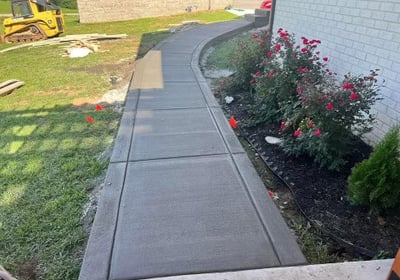
'Cure' is one of the most misunderstood words in concrete. People hear it and think dry — that the concrete has hardened and is done. It is not. Concrete cures through a chemical reaction that continues for weeks after the surface looks finished. The timeline for when you can walk on it, drive on it, and load it matters a lot to how the slab performs over its life. Here is the real cure timeline.
01The first few hours: set and finishing
After the pour, concrete goes through an initial set where it changes from workable to stiff. This is when the finisher works — floating, edging, jointing, and applying the final texture. You should not walk on fresh concrete during this window. The surface is soft and any mark becomes permanent.
0224 hours: walkable but not loadable
By the next day, most residential concrete is stiff enough to walk on carefully. It is not at full strength — maybe 25 to 30 percent of its eventual strength — but it will hold foot traffic. Keep vehicles, heavy equipment, and anything that concentrates weight off the slab for at least several more days.
033 to 7 days: light vehicle traffic
By about 7 days, a properly cured residential slab has reached roughly 65 to 70 percent of its design strength. Cars can be parked on a driveway after a week, though we prefer to keep heavy trucks and trailers off longer. Construction traffic — framers, deliveries — should still be minimized.
0428 days: full design strength
Concrete reaches its specified design strength at 28 days under proper curing conditions. That is the industry standard and the number on the mix design. After 28 days, the slab is as strong as it is going to get, though the chemical reaction continues at a much slower rate for years. This is when you can apply a penetrating sealer and treat the slab as a finished, durable surface.
05Curing vs. drying
Curing is the chemical reaction that gives strength. Drying is the loss of excess water to the air. They are related but different. A slab can cure fully and still be damp inside. For most outdoor applications, the moisture that remains inside the slab after curing is fine. For interior slabs that will receive a coating or floor covering, the slab needs to dry to a specific moisture level before the covering goes down.
06How to cure properly
Proper curing keeps moisture in the slab so the reaction can continue. The methods are curing compound (a liquid membrane that seals the surface), wet curing (covering the slab with wet burlap or plastic and keeping it damp), or ponding water on flatwork. Without curing, the surface dries out, the reaction stalls near the surface, and you get a weak, dusty, scaled surface even if the interior is strong.
In Tennessee summer, the heat and low humidity pull moisture out of the slab fast, so curing is even more important. In winter, curing protects against freeze and keeps the reaction going.
07Signs of poor curing
A poorly cured slab shows dusting (a soft, dusty surface that scratches easily), scaling (flaking of the surface), and surface cracks called plastic shrinkage cracks. If your new concrete shows these in the first year, the cure was inadequate. It is preventable, which is why we cure every pour.
Key Takeaway
Concrete is walkable in 24 hours, drivable in 7 days, and at full strength in 28 days. Keep moisture in the slab through curing so it reaches its design strength instead of a weak, dusty surface.
Related Service
Patios, Walkways & Pool Decks
Elegant outdoor entertaining slabs, curving garden paths, and non-slip pool surrounds.
View service details & pricingMore on Concrete Maintenance
Ready to talk to a real concrete crew?
Free on-site estimates across Middle & Southern Tennessee. No obligation.