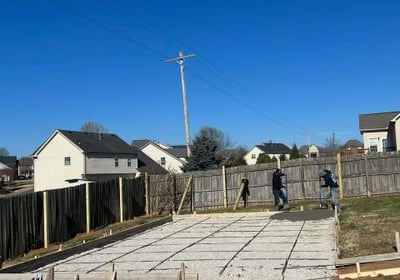
Concrete does not stop being workable in the winter, but it does change the rules. Cold temperatures slow the chemical reaction that gives concrete its strength, and a pour that freezes before it has cured can be permanently damaged. Middle Tennessee winters are not as severe as northern states, but we get enough freeze-thaw cycles and the occasional hard freeze that winter concrete work deserves real attention. Here is what changes.
01The chemistry: concrete cures by reaction, not by drying
A common misconception is that concrete 'dries.' It actually cures through a chemical reaction between cement and water called hydration. That reaction generates heat and is temperature-sensitive. Below about 50 degrees Fahrenheit, it slows significantly. If the concrete freezes before it reaches a minimum strength — roughly 500 PSI — the water inside expands and breaks the matrix, and the damage is permanent.
This is why timing matters: concrete that has cured for a day or two can survive a freeze, but fresh concrete usually cannot.
02When you should avoid pouring
We avoid pouring when the temperature is forecast to drop below freezing within 24 hours of the pour, or when the daytime high will not climb above 40 degrees. We also watch wind and humidity — wind accelerates moisture loss, and low humidity does the same. In Tennessee, the safest windows are the warmer parts of the day, typically late morning through afternoon, when temperatures peak.
03How contractors protect a winter pour
When a winter pour is necessary, we use several tools: warmer water in the mix to accelerate the reaction, accelerators like calcium chloride (when appropriate for the application), insulated blankets over the slab to trap heat, and windbreaks around the forms. The goal is to keep the concrete above 50 degrees for the first few days while it gains early strength.
We also wait longer before removing forms and before allowing traffic. What cures in 3 days in July may take 7 in January.
04Air entrainment matters more in winter
Air-entrained concrete contains microscopic air bubbles that give freezing moisture room to expand inside the slab instead of cracking the surface. For any concrete exposed to freeze-thaw — driveways, patios, walkways — air entrainment is not optional in our climate. If you are pouring in or before winter, confirm the mix includes it.
05Curing and sealing in cold weather
Curing compounds and wet curing still matter in winter, sometimes more, because the slower reaction means the concrete is vulnerable longer. We avoid applying sealers when temperatures are too low — most penetrating sealers need surface temperatures above 40 to 50 degrees to cure properly. Sealing a cold, damp slab traps moisture and causes problems.
06Planning around the weather window
The best winter strategy is to plan pours for the warmest available window and watch the forecast. A pour on a 55-degree afternoon followed by a 35-degree night under blankets is fine. A pour in a steady 30-degree drizzle is not. If you have flexibility on timing, use it — waiting two weeks for better weather is almost always cheaper than repairing a freeze-damaged slab.
Key Takeaway
Concrete can be poured in Tennessee winters with the right protections — warm water, accelerators, insulated blankets, air entrainment, and careful timing. Avoid pours that will freeze before curing, and plan around the warmest available window.
Related Service
Foundations, Slab-on-Grade & Garages
Precision poured foundations, monolithic garage slabs, shop floors, and shed pads.
View service details & pricingMore on Concrete Maintenance
Ready to talk to a real concrete crew?
Free on-site estimates across Middle & Southern Tennessee. No obligation.