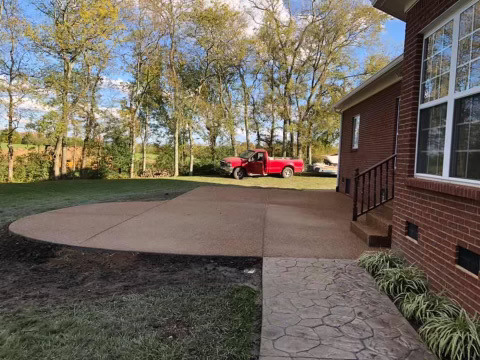
Concrete is one of the most permanent things you will ever add to a property. Done well, a driveway or patio lasts 30 to 40 years with minimal attention. Done poorly, it cracks within two winters, drains water toward your foundation, and has to be torn out before it has paid for itself. The difference between those outcomes is almost never the price of the bid — it is the contractor you hired. This checklist is what we walk every new GM Concrete customer through before we ever pour a yard of concrete.
01Verify the license and insurance before the first visit
In Tennessee, a contractor pulling residential concrete work should be able to show you a current license number and proof of both general liability insurance and workers' compensation coverage. Our license number is on every estimate we send, and we encourage every homeowner to ask for it up front. If a contractor cannot or will not provide license and insurance documentation, that is a hard stop — not a negotiating point.
Insurance matters more than people realize. Concrete is heavy, wet, and chemically active. A crew without coverage means an on-site injury or property damage becomes your problem, not theirs.
02Ask about the concrete mix design, not just the price
Concrete is sold by strength, measured in PSI (pounds per square inch). A residential driveway in Middle Tennessee should be poured with at minimum a 4,000 PSI mix. Sidewalks and patios can sometimes go lighter, but driveways, garage floors, and any slab that carries vehicle weight should never drop below 4,000 PSI. If a bid does not specify the mix, ask. If the contractor cannot answer, that tells you something.
Air entrainment matters in our climate too. Tennessee freezes and thaws dozens of times each winter, and entrained air gives freezing moisture somewhere to expand inside the concrete instead of cracking the surface.
03Sub-base preparation is where shortcuts hide
The single most common reason concrete cracks prematurely is a poorly prepared sub-base. Before any pour, the ground underneath should be compacted, leveled, and free of organic material and standing water. A good contractor will describe their sub-base process in the estimate. A cheap bid that skips this step will cost you more in three years than you saved on day one.
On clay-heavy Middle Tennessee soils, we routinely add and compact a gravel base before we set forms. It is not optional — it is what keeps a slab from settling and heaving.
04Get the reinforcement spelled out
Rebar or wire mesh reinforcement is standard on driveways and any slab that carries load. The size, spacing, and placement of that steel should be in the estimate. Reinforcement that sits on the dirt instead of being chaired up into the middle of the slab does almost nothing. This is a question worth asking.
05Control joints are planned, not improvised
Concrete will crack — that is a fact. Control joints are how we tell the concrete where to crack. A qualified contractor plans joint placement based on slab geometry and thickness, and cuts them at the right depth at the right time. Ask your contractor how they plan control joints. If they say the concrete 'won't need them,' find a different contractor.
06Curing is not optional
Fresh concrete needs moisture and time to reach its rated strength. A contractor who pours and walks away is leaving strength on the table. Proper curing — through curing compound, wet burlap, or controlled water application — can be the difference between a slab that holds up and one that dusts and scales within a year.
07Written estimates protect both sides
Every estimate should be written, itemized, and reference the scope, mix, reinforcement, finish, and cleanup. Verbal quotes leave both parties guessing. We send written estimates on every project because it is how we hold ourselves accountable.
08Warranty and call-backs
Ask what happens if something goes wrong. A contractor confident in their work will stand behind it with a defined warranty and a willingness to come back. The answer to this question tells you how the contractor thinks about their own work.
09Timeline and crew
Concrete has a window. If the pour is delayed by weeks because the contractor is overbooked, you may miss the weather window entirely. Ask who actually shows up — is it their crew or a subcontractor? How long does a typical residential driveway take start to finish? A reliable contractor gives you a realistic timeline, not the one you want to hear.
10References and past work
Ask for addresses of recent completed work you can drive by. Concrete is visible and verifiable. A contractor who cannot point to recent local projects is worth questioning. In Middle Tennessee, we can point to driveways and patios we poured years ago that still look right.
11Site cleanup and haul-off
A pour leaves behind form lumber, excess concrete, and debris. A professional contractor hauls it off and leaves the site clean. That should be in the estimate. The cheapest bid sometimes leaves you with a pile of broken concrete in the backyard.
12Permits and inspection
Depending on your county and the scope, permits may be required. A licensed contractor handles permitting as part of the job. If a contractor asks you to pull your own permit to avoid inspection, treat that as a warning sign.
13Trust your gut on communication
The bid stage is the best the contractor will ever communicate with you. If calls go unanswered before you have signed anything, they will not get better after. Hire the contractor who answers the phone, shows up when they say they will, and explains things in language you understand. That is the contractor whose work will still look good in ten years.
Key Takeaway
A reliable concrete contractor is licensed, insured, specifies the mix and reinforcement in writing, prepares the sub-base, plans control joints, cures the slab, and communicates clearly. Price is the last thing to compare.
Related Service
Concrete Driveways & Paving
Durable, high-load concrete driveway pour, replacement, widening, and custom finishes.
View service details & pricingMore on Contractor Advice
Ready to talk to a real concrete crew?
Free on-site estimates across Middle & Southern Tennessee. No obligation.