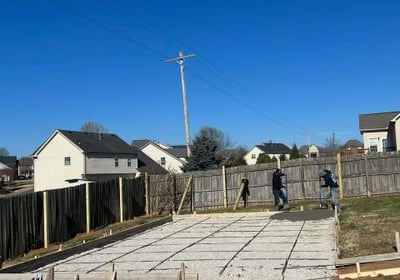
The strength of a foundation is decided before a single yard of concrete is ordered. By the time the truck arrives, the work that determines whether the slab settles, cracks, or holds true for a century is already done — in the excavation, the compaction, the drainage, and the formwork. When a foundation fails in Middle Tennessee, we can almost always trace the cause back to what happened under it, not what was poured on top of it. Here is what site preparation actually does.
01Excavation to the right depth
A foundation needs to bear on soil that can carry the load. In Tennessee, that means excavating below the topsoil and any organic material down to stable subgrade, and below the frost depth for shallow footings. A foundation bearing on topsoil or fill will settle, because organic material compresses and decays. Depth is not a luxury — it is the first thing that determines whether the slab stays where you put it.
02Compaction of the subgrade
Once we are at the right depth, the subgrade is compacted. Loose soil under a slab compresses under load over time, and the slab above it settles and cracks. Proper compaction — usually with a plate compactor or roller in lifts — gives the ground the density it needs to carry the foundation without movement.
On Tennessee clay, we pay particular attention to moisture during compaction. Clay that is too wet or too dry does not compact correctly.
03Drainage and water management
Water is the most common cause of foundation trouble. If water collects under or around the slab, it erodes the subgrade, saturates clay and causes it to expand and shrink with the seasons, and undermines footings. A proper foundation pour includes a plan for where water goes — surface grading away from the slab, foundation drains where needed, and a gravel base that sheds water instead of holding it.
On sloped Tennessee lots, this is even more important. A foundation at the bottom of a slope without drainage is a problem waiting to happen.
04The gravel base layer
Under most slabs we place a layer of compacted gravel — typically a clean crushed stone — over the prepared subgrade. The gravel base does three things: it provides a uniform bearing surface, it breaks capillary action so moisture does not wick up from the soil into the slab, and it gives a level surface to set forms and reinforcement. Skipping the gravel base to save money is a common shortcut with expensive consequences.
05Vapor barriers under the slab
For interior living spaces — garage slabs, basement floors, shop floors — a vapor barrier under the slab stops ground moisture from migrating up through the concrete. Without it, you get dampness, efflorescence, and in enclosed spaces, humidity problems. The vapor barrier is a thin sheet that costs little and does a lot.
06Formwork and reinforcement placement
Forms set the shape and the finished elevation, so they need to be braced and leveled accurately. Reinforcement — rebar or wire mesh — is placed on chairs so it sits in the middle of the slab, not on the gravel. Reinforcement on the gravel does almost nothing because it is below the neutral axis of the slab. Getting the steel up into the concrete is what makes it work.
07Why site prep is where the money goes
When you compare two foundation bids and one is much cheaper, the difference is almost always in the site preparation. The cheaper bid skips excavation, compaction, gravel base, or drainage — because you cannot see any of that once the concrete is poured. A foundation poured on bad prep looks identical to one poured on good prep on day one. The difference shows up in three to ten years, when the cheap one settles and cracks.
If a bid is significantly cheaper, ask exactly what is being skipped. The answer tells you what you are buying.
Key Takeaway
Foundation strength comes from excavation to the right depth, subgrade compaction, drainage, a gravel base, vapor barrier, and correctly placed reinforcement — all before the pour. Skimping here fails in three to ten years.
Related Service
Foundations, Slab-on-Grade & Garages
Precision poured foundations, monolithic garage slabs, shop floors, and shed pads.
View service details & pricingMore on Foundations
Ready to talk to a real concrete crew?
Free on-site estimates across Middle & Southern Tennessee. No obligation.